Insecticidal Soap for Psyllids
Garden Soap Team
· 8 min read
What Are Psyllids?
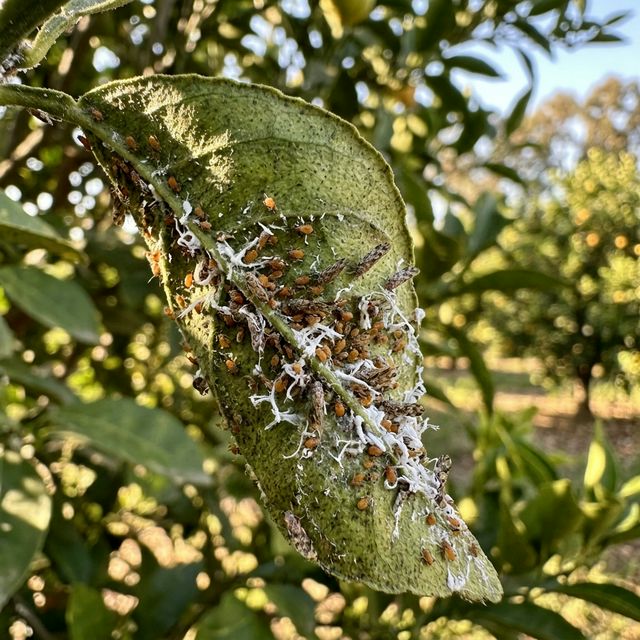
Psyllids (pronounced “SIL-ids”) are tiny sap-sucking insects that most gardeners have never heard of, even if they’re currently infesting their plants. They belong to the order Hemiptera, making them relatives of aphids and whiteflies, and they cause similar damage: curled leaves, stunted growth, and sticky honeydew.
What makes psyllids especially dangerous is their role as disease vectors. Several psyllid species transmit devastating plant diseases that are far worse than the feeding damage itself.
Adult psyllids look like miniature cicadas, about 1/8 inch long with clear wings held roof-like over their body. They jump when disturbed (their name comes from the Greek “psylla,” meaning flea). Nymphs are flat, oval, nearly immobile, and often surrounded by white waxy threads or sugary secretions called lerps.
Major Psyllid Species in Gardens
Asian Citrus Psyllid (Diaphorina citri)
This is the most destructive psyllid in North America. It feeds on all citrus trees and spreads Huanglongbing (HLB), also called citrus greening disease, which is lethal to citrus with no cure. If you grow citrus in Florida, Texas, California, or other warm states, this psyllid is your most serious pest.
Identification:
- Adults are mottled brown, 3-4mm, feed at a 45-degree angle to the leaf surface
- Nymphs are yellowish-green, flat, produce waxy tubules
- Found on new growth flush (soft, emerging leaves)
Tomato/Potato Psyllid (Bactericera cockerelli)
A major pest in western North America that feeds on tomatoes, potatoes, peppers, and eggplant. It transmits Candidatus Liberibacter solanacearum, causing zebra chip disease in potatoes and psyllid yellows in tomatoes.
Identification:
- Adults are black with white markings, about 2mm
- Nymphs are green and scale-like, found on leaf undersides
- Look for “psyllid sugars”, crystalline deposits on leaves
Pear Psyllid (Cacopsylla pyricola)
Common in pear orchards and home pear trees. Heavy infestations cause honeydew, sooty mold, and reduced fruit quality.
Eucalyptus Psyllids
Several species attack eucalyptus trees, forming lerps (hard sugar coverings over nymphs) on leaves.
Why Insecticidal Soap Works Well on Psyllids
Psyllids are ideal targets for insecticidal soap:
| Characteristic | Why It Makes Them Vulnerable |
|---|---|
| Soft body | Thin cuticle easily penetrated by fatty acid salts |
| Small size (1-3mm) | Rapid dehydration once cuticle is breached |
| Sedentary nymphs | Can’t escape spray coverage |
| Feed on leaf surfaces | Exposed to contact sprays |
| Cluster on new growth | Concentrated targets for efficient spraying |
Psyllid nymphs are especially vulnerable because they’re essentially immobile, flattened against the leaf surface. Unlike adult psyllids that jump away, nymphs can’t escape a well-aimed spray.
How to Use Insecticidal Soap Against Psyllids
Recipe
The standard castile soap spray is effective:
- 1 tablespoon pure liquid castile soap per quart of water
- For heavy infestations: 2 tablespoons per quart
- Adding neem oil (1 teaspoon per quart) provides systemic anti-feeding effects and growth disruption that extends protection between sprays
Target Areas
Psyllids congregate on new, tender growth. Focus your spray on:
- Growing tips and new leaf flushes, this is where adults feed and lay eggs
- Leaf undersides on the newest leaves
- The junction of new leaves where they emerge from the stem
- Flower buds on citrus and pear trees
Don’t waste spray on mature, hardened leaves unless you see nymphs there. Psyllids overwhelmingly prefer young tissue.
Spray Technique
- Approach carefully. Adult psyllids jump at the slightest disturbance. Move slowly.
- Start at the top. New growth is usually at branch tips and the top of the plant.
- Spray until dripping. You need thorough coverage to contact the flat-bodied nymphs pressed against leaf surfaces.
- Flip small leaves. On citrus, new flush leaves are small enough to turn individually.
- Get the growing points. Spray directly into the tight cluster of emerging leaves at each branch tip.
Application Schedule
| Application | Timing | Target |
|---|---|---|
| First spray | When new growth appears | Prevent egg-laying on new flush |
| Second spray | 5 days later | Kill nymphs from eggs already laid |
| Third spray | 5-7 days later | Catch next generation of nymphs |
| Fourth spray | 7 days later | Clean up remaining population |
| Maintenance | Every 2 weeks during growth flushes | Prevent re-infestation |
For citrus trees, time your applications to coincide with new growth flushes. Citrus typically produces 3-4 flushes per year (spring, summer, fall), and each flush is vulnerable to psyllid colonization.
Special Considerations for Citrus Psyllids
If you grow citrus in areas where Asian citrus psyllid is present, the stakes are higher than with most pests. HLB (citrus greening) has no cure and will eventually kill infected trees. Every Asian citrus psyllid that feeds on your tree is a potential disease vector.
An Aggressive Approach Is Justified
- Spray insecticidal soap on every new growth flush without waiting to see psyllids
- Inspect new growth weekly for the distinctive 45-degree feeding posture of adults
- Report any suspected HLB symptoms (blotchy mottled yellowing on leaves, asymmetric yellowing on fruit) to your local agricultural extension office
- In quarantine areas, follow all local regulations regarding psyllid management
Protecting Young Citrus Trees
Young citrus trees (under 4 years) flush more frequently than mature trees, giving psyllids more opportunities:
- Consider covering young trees with fine mesh screening during growth flushes
- Apply soap spray weekly during active flush periods
- Supplement with systemic neem drenches (1 tablespoon neem oil + soap emulsifier per gallon, applied to soil)
- Remove any new shoots that appear between scheduled flushes, these “sucker” shoots attract psyllids
Managing Mature Citrus Trees
Mature citrus trees produce fewer, more synchronized flushes:
- Time soap applications to flush cycles
- Focus on the outer canopy where new growth emerges
- Accept that complete coverage is impossible on large trees, focus on reachable growth
- Encourage natural enemies (see below)
Tomato and Potato Psyllid Management
For vegetable gardens in western states, tomato/potato psyllids require a different approach because the crop cycle is shorter:
In-Season Soap Spray Protocol
- Begin monitoring transplanted tomatoes and potatoes within 2 weeks of planting
- Check leaf undersides for tiny flat nymphs and “psyllid sugars” (crystalline white granules)
- At first sign of infestation, spray soap on all leaf undersides
- Repeat every 5 days for 3-4 applications
- Continue weekly monitoring throughout the season
Cultural Controls
- Yellow sticky traps above the plant canopy detect adult psyllids early
- Reflective mulch (silver or aluminum) reduces psyllid landing, similar to its effect on leafhoppers
- Remove solanaceous weeds (nightshade, ground cherry) that harbor psyllids
- Use certified disease-free seed potatoes
Beneficial Insects That Control Psyllids
Several natural enemies are effective against psyllids and can be conserved through responsible pest management:
- Tamarixia radiata, a parasitic wasp specifically targeting Asian citrus psyllid, released as a biological control agent in many states
- Ladybugs eat both psyllid nymphs and adults
- Lacewing larvae are effective generalist predators against nymphs
- Syrphid fly larvae (hoverfly larvae) consume nymphs
- Minute pirate bugs feed on psyllid eggs and nymphs
One of insecticidal soap’s greatest advantages over synthetic pesticides is its compatibility with biological control. Since soap has no residual toxicity, beneficial insects that arrive after the spray dries are completely unaffected. This allows you to spray for psyllids without disrupting the natural enemies that provide ongoing, free pest control.
Recognizing Psyllid Disease Symptoms
Citrus Greening (HLB)
- Asymmetric blotchy mottling of leaves (not uniform yellowing)
- Fruit that stays green at the stem end while ripening at the bottom
- Lopsided, bitter fruit
- Gradual decline of the tree over 3-5 years
Zebra Chip (Potatoes)
- Purple or lilac discoloration of upper leaves
- Swollen nodes
- When tubers are fried, dark zebra-stripe patterns appear in the flesh
- Reduced tuber size and quality
Psyllid Yellows (Tomatoes)
- Purple discoloration of upper leaf margins
- Upward curling of new leaves
- Yellowing and stunted growth
- Reduced fruit set
If you see disease symptoms, remove and destroy affected plants immediately. The plant cannot be saved, and every psyllid that feeds on a diseased plant can spread the pathogen to healthy plants.
Long-Term Prevention
- Monitor new growth consistently. Psyllid infestations start small and explode quickly.
- Manage weeds that serve as alternate hosts
- Maintain plant health through proper watering and fertilization, stressed plants are more susceptible
- Encourage natural enemies by planting diverse flowering plants and avoiding broad-spectrum pesticides
- Inspect nursery plants before purchase, psyllids spread easily on infected plant material
- Join local pest monitoring programs if available, especially for citrus psyllids
For the complete organic pest management framework, see our guides on integrated pest management and natural pest control methods.
Frequently Asked Questions
Does insecticidal soap kill psyllids? ▼
Yes, insecticidal soap effectively kills psyllid nymphs and adults on direct contact. Psyllids are small, soft-bodied sap feeders with thin cuticles that make them highly vulnerable to the fatty acid salts in soap spray.
What are psyllids? ▼
Psyllids are tiny (1-3mm) sap-sucking insects related to aphids and whiteflies. They look like miniature cicadas with wings held roof-like over their body. Nymphs are flat, scale-like, and often surrounded by waxy secretions. Several species are serious crop pests.
How do psyllids damage plants? ▼
Psyllids damage plants in two ways: directly by sucking sap (causing curled, distorted leaves and reduced growth) and indirectly by transmitting diseases. Citrus psyllids spread HLB (citrus greening disease), and potato psyllids transmit zebra chip disease.
How often should I spray for psyllids? ▼
Spray insecticidal soap every 5-7 days for at least 4 applications during active psyllid seasons. Focus on new growth where psyllids feed and lay eggs. Continue monitoring every 1-2 weeks after the initial treatment series and spot-treat new infestations.
 ✓
✓ The Garden Soap Team writes every recipe and guide on this site. Formulas follow published horticultural guidance — university extension resources, the UC IPM program, and OMRI standards — and we cross-check concentrations and plant-safety warnings against documented gardener experience before publishing. No harsh chemicals, no guesswork passed off as expertise.
📚 Related Articles
 guides
How to Make Insecticidal Soap at Home
Core 3-ingredient method: 1 tablespoon unscented castile per quart, leaf-underside coverage, and the mixing mistakes that burn plants.
 guides
Insecticidal Soap for Tomatoes
Tomatoes attract aphids, whiteflies, and hornworms. Insecticidal soap handles the first two safely without harming fruit. Here's the tomato-specific guide.
 guides
Insecticidal Soap for Fruit Trees
Fruit trees face aphids, scale, spider mites, and more. Insecticidal soap offers safe, organic pest control without contaminating your harvest.