Insecticidal Soap for Cabbage Worms
Garden Soap Team
· 8 min read
The Cabbage Worm Challenge
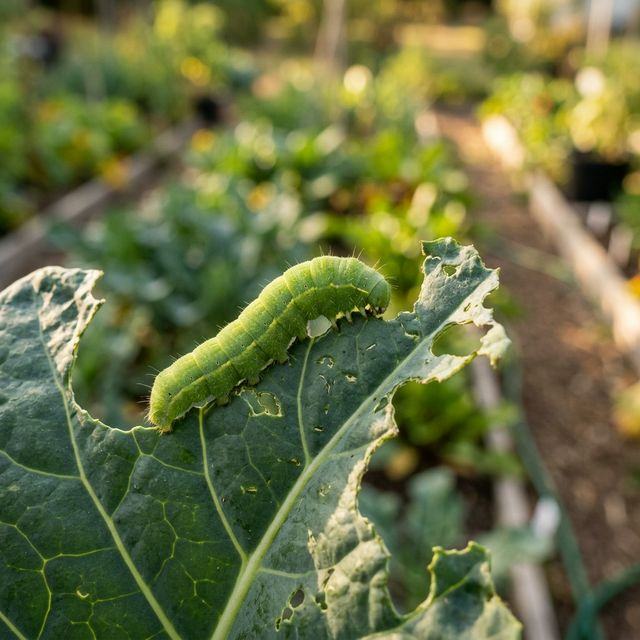
You plant kale, broccoli, cauliflower, or Brussels sprouts and within weeks those familiar white butterflies start circling your garden. They look harmless and even pleasant. They’re not. Each one is laying dozens of tiny eggs on your brassica leaves, and each egg hatches into a hungry green caterpillar that can shred a cabbage leaf in days.
The imported cabbageworm (Pieris rapae) is the most common caterpillar pest of brassica crops across North America. They’re the velvety green caterpillars with a faint yellow stripe that you find munching through your kale, leaving behind ragged holes and dark green frass (caterpillar droppings). Smooth green caterpillars that inch in a looping motion are cabbage loopers, a different species with the same Bt-first treatment.
Most organic gardeners reach for insecticidal soap first because it works so well on other pests. For cabbage worms, though, soap spray is not your best tool. Here’s why, and what to use instead.
Why Insecticidal Soap Underperforms on Cabbage Worms
Insecticidal soap kills by dissolving the waxy cuticle of soft-bodied insects, causing dehydration. This works brilliantly on aphids, whiteflies, and spider mites because they’re tiny and have extremely thin cuticles.
Cabbage worms present three problems:
1. They’re not small. A mature cabbage worm is 1-1.5 inches long. That’s a lot of body mass for soap to dehydrate. Even thorough coverage doesn’t reliably kill larger caterpillars.
2. Their cuticle is tougher. Caterpillar skin isn’t as thin as an aphid’s membrane. While not armored like a beetle, it resists the soap’s cuticle-dissolving action better than truly soft-bodied insects.
3. They hide where spray doesn’t reach. Cabbage worms feed deep inside cabbage and broccoli heads, in leaf folds, and along the central ribs of leaves. Even aggressive spraying misses them.
| Pest | Size | Cuticle | Soap Kill Rate |
|---|---|---|---|
| Aphids | 1-3mm | Very thin | 90%+ |
| Whiteflies | 1-2mm | Thin | 85%+ |
| Small cabbage worm (first instar) | 3-5mm | Moderate | 40-50% |
| Large cabbage worm (late instar) | 20-35mm | Tough | Under 20% |
You might kill some very young, newly hatched caterpillars with a direct soap spray, but once they reach even a few days old, soap becomes unreliable.
What Actually Works: Bt (Bacillus thuringiensis)
Bt is the organic gardener’s best weapon against caterpillars. It’s a naturally occurring soil bacterium that produces crystal proteins (Cry toxins) lethal specifically to caterpillar larvae. When a cabbage worm eats Bt-treated leaf tissue, the toxin dissolves in its alkaline gut, destroying the gut lining. The caterpillar stops feeding within hours and dies within 1-3 days.
Why Bt Is Superior to Soap for Caterpillars
- It’s a stomach poison, not a contact killer. The caterpillar has to eat treated leaf tissue, which cabbage worms do constantly
- It’s highly selective. Only Lepidoptera (moth and butterfly) larvae are affected. Bees, ladybugs, parasitic wasps, and other beneficial insects are unharmed
- It works even on hidden caterpillars. As long as they eat a treated leaf, they’re affected, regardless of whether your spray reached them directly
- It’s OMRI certified organic
How to Apply Bt
- Mix according to label directions (typically 1-2 teaspoons per gallon of water)
- Add a few drops of castile soap as a spreader-sticker to help Bt adhere to waxy brassica leaves
- Spray all leaf surfaces, especially the undersides where caterpillars feed
- Apply in late afternoon (UV light breaks down Bt, so evening application lasts longer)
- Reapply every 5-7 days and after rain
Here’s where insecticidal soap and Bt work together: adding a small amount of soap to your Bt spray helps it stick to the waxy, water-repellent surfaces of brassica leaves. The soap acts as a surfactant, not a pesticide, in this combination.
Using Soap Spray as Part of Your Strategy
Even though soap doesn’t kill cabbage worms effectively, it has supporting roles:
Kill Aphids on Brassicas
Brassicas attract both caterpillars and aphids (especially cabbage aphids and green peach aphids). Insecticidal soap handles the aphid problem while Bt handles the caterpillars. You can mix Bt into your soap spray to address both pests in one pass.
Wash Off Eggs
A strong spray of soapy water can physically dislodge butterfly eggs from leaf surfaces before they hatch. This isn’t the soap’s insecticidal action but rather mechanical removal.
Kill Very Young Larvae
If you catch caterpillars within hours of hatching, when they’re still tiny and thin-skinned, a direct soap spray can kill some of them. This is inconsistent but provides marginal benefit as part of a broader strategy.
Identifying the Caterpillar Culprits
Three main caterpillar species attack brassicas:
Imported Cabbageworm (Pieris rapae)
- Adult: White butterfly with black wing tips, 1-2 black spots on wings
- Caterpillar: Velvety green, faint yellow stripe down the back
- Feeding: Chews irregular holes from leaf edges inward
- Frass: Dark green pellets on leaves
Cabbage Looper (Trichoplusia ni)
- Adult: Brown moth, silver figure-8 mark on wings, flies at night
- Caterpillar: Smooth green, moves in a distinctive “looping” motion (arching its body like an inchworm)
- Feeding: Creates large irregular holes in leaves
- Frass: Similar to cabbageworm
Diamondback Moth (Plutella xylostella)
- Adult: Small gray-brown moth with diamond pattern when wings are folded
- Caterpillar: Tiny (less than 1/2 inch), pale green, wiggles violently when disturbed
- Feeding: Creates small “windowpane” holes in leaves, eating one side of the leaf but leaving the other
- Frass: Very small
All three are controlled by Bt. Insecticidal soap is equally ineffective against all three.
Prevention: Row Covers Are the Best Defense
The white butterflies that lay cabbageworm eggs can be completely excluded with floating row covers:
- Install at transplanting. Cover brassicas with lightweight row cover fabric immediately after planting
- Seal all edges with soil, sandbags, or field staples. Any gap is an entry point.
- Leave covers on for the entire season. Brassicas don’t need pollination (you’re harvesting leaves, heads, and buds, not fruit)
- This is nearly 100% effective when installed properly before butterflies arrive
Row covers also protect against flea beetles, another common brassica pest, making them the single most valuable tool for organic brassica growing.
Hand-Picking: Simple and Effective
For small gardens, hand-picking is surprisingly practical:
- Check plants every 1-2 days. Look on leaf undersides and along the central rib
- Look for frass first. Dark green pellets on lower leaves mean caterpillars are above
- Check deep inside heads. Broccoli and cabbage heads hide caterpillars in their folds
- Drop caterpillars into a bucket of soapy water
- Crush eggs when you find them (tiny yellow or pale green dots on leaf undersides)
In a typical home garden with 10-20 brassica plants, a 5-minute daily check can eliminate caterpillars without any spraying at all.
Encouraging Natural Enemies
Several beneficial insects prey on cabbage worms:
- Paper wasps are excellent cabbage worm predators, they actively hunt caterpillars to feed their larvae
- Parasitic wasps (Cotesia glomerata) lay eggs inside caterpillars, eventually killing them. If you see a caterpillar covered in small white cocoons, that’s Cotesia at work. Leave it alone.
- Birds (especially house sparrows) eat caterpillars. A birdbath near the garden encourages feeding visits
- Ground beetles eat caterpillars that fall to the ground
Avoid broad-spectrum sprays (even organic ones like pyrethrin) that kill these allies. This is another reason Bt is preferred over soap spray: Bt’s high selectivity preserves beneficial insect populations.
Companion Planting for Brassicas
Several plants can reduce cabbage worm pressure:
- Thyme, sage, and rosemary have strong aromas that may confuse egg-laying butterflies
- Red or purple varieties of cabbage and kale seem to attract fewer caterpillars (the green larvae are more visible to predators against purple leaves)
- Dill and fennel attract parasitic wasps
- Nasturtiums act as trap crops, drawing pests away from brassicas
For more companion planting ideas, see our guide on plants that repel bugs.
Season-Long Management Calendar
| Time | Action |
|---|---|
| Before planting | Check garden debris for overwintering pupae |
| At transplanting | Install row covers immediately |
| Weekly | Scout for eggs and caterpillars under covers (lift and check) |
| If caterpillars found | Apply Bt + soap surfactant every 5-7 days |
| Mid-season | Check for aphids and treat with insecticidal soap |
| After harvest | Remove all brassica debris to reduce overwintering sites |
| Fall | Plan crop rotation for next year |
The Bottom Line
Insecticidal soap is a poor choice as a primary control for cabbage worms. Use Bt for caterpillars, row covers for prevention, and hand-picking for small infestations. Save your soap spray for the aphids and whiteflies that also target brassica crops, where it genuinely excels.
Frequently Asked Questions
Does insecticidal soap kill cabbage worms? ▼
Insecticidal soap has limited effectiveness against cabbage worms. These caterpillars have relatively tough skin compared to soft-bodied pests like aphids, and they're larger, making it harder for soap to cause fatal dehydration. Bt (Bacillus thuringiensis) is the superior organic option for caterpillars.
What is the best organic spray for cabbage worms? ▼
Bt (Bacillus thuringiensis var. kurstaki) is the gold standard organic spray for cabbage worms. It's a naturally occurring soil bacterium that produces proteins toxic only to caterpillars. It's safe for beneficial insects, pets, and people.
How do I prevent cabbage worms naturally? ▼
Floating row covers are the most effective prevention. Cover brassica plants immediately after transplanting with lightweight fabric secured at the edges. This physically blocks the white butterflies from laying eggs on your plants.
Are cabbage worms and cabbage loopers the same thing? ▼
No. Cabbage worms (imported cabbageworm) are velvety green caterpillars from white butterflies. Cabbage loopers are smooth green caterpillars from brown moths that move in a looping motion. Both damage brassicas but they're different species requiring the same treatment.
 ✓
✓ The Garden Soap Team writes every recipe and guide on this site. Formulas follow published horticultural guidance — university extension resources, the UC IPM program, and OMRI standards — and we cross-check concentrations and plant-safety warnings against documented gardener experience before publishing. No harsh chemicals, no guesswork passed off as expertise.
📚 Related Articles
 guides
How to Make Insecticidal Soap at Home
Core 3-ingredient method: 1 tablespoon unscented castile per quart, leaf-underside coverage, and the mixing mistakes that burn plants.
 guides
Natural Pesticides for Vegetable Gardens
Six extension-guided tools for edible beds: contact soap first, then neem, Bt, and companions. Ranked by pest — not by the loudest organic label.
 guides
When to Spray Insecticidal Soap for Best Results
Timing is everything with insecticidal soap. Learn the best time of day, season, and growth stage to spray for maximum pest control.