Insecticidal Soap for Cabbage Loopers
Garden Soap Team
· 8 min read
More Than Just a Cabbage Pest
Despite their name, cabbage loopers (Trichoplusia ni) have one of the broadest appetites of any garden caterpillar. They’ll eat more than 160 plant species, including crops you wouldn’t expect: lettuce, spinach, beets, celery, tomatoes, potatoes, and even watermelon. If you grow vegetables, you’ll eventually meet them.
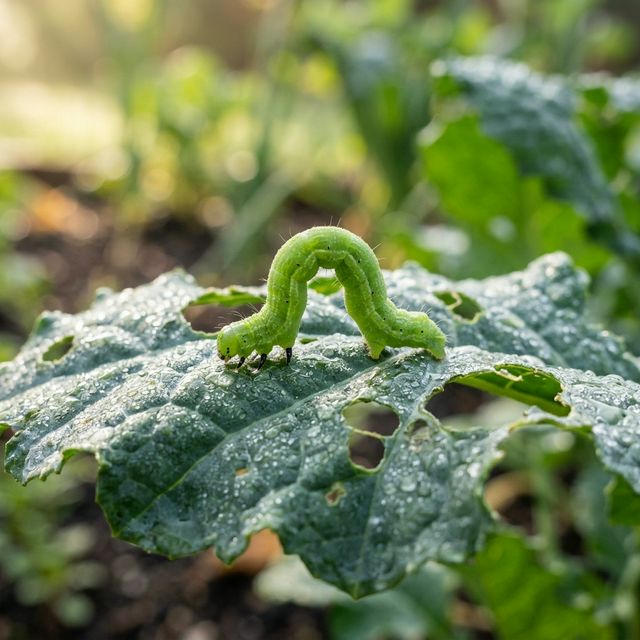
Cabbage loopers get their name from their distinctive locomotion. Unlike caterpillars that have legs along their entire body, loopers have legs only at the front and back. They move by arching their midsection into a loop, pulling their back end forward to meet the front, then extending forward again, the classic inchworm movement.
You’ll recognize them as smooth, pale green caterpillars about 1.5 inches long with a thin white stripe along each side. They’re voracious feeders that can consume three times their body weight in plant tissue daily. A moderate infestation will leave your brassica leaves full of large, ragged holes.
Why Soap Spray Falls Short
Like their close relative the imported cabbageworm, cabbage loopers are poor targets for insecticidal soap. The reasons are the same:
Size matters. A mature cabbage looper is over 1 inch long, far too much body mass for soap to dehydrate through surface contact alone. Compare that to an aphid at 1-3mm that soap kills in minutes.
Caterpillar skin is tougher. Lepidoptera larvae have thicker cuticles than true soft-bodied insects. Soap can’t penetrate efficiently enough to cause fatal dehydration.
They feed in protected spots. Loopers work their way into cabbage heads, broccoli florets, and leaf folds where spray coverage is nearly impossible.
| Control Method | Effectiveness Against Cabbage Loopers |
|---|---|
| Insecticidal soap | 15-25% kill rate |
| Bt (Bacillus thuringiensis) | 85-95% kill rate |
| Spinosad | 80-90% kill rate |
| Hand-picking | 90%+ (small gardens) |
| Row covers | Near 100% prevention |
The numbers speak for themselves. Your time and soap are better spent on pests where soap excels.
Bt: The Superior Organic Caterpillar Control
Bt (Bacillus thuringiensis var. kurstaki) is a naturally occurring soil bacterium that produces proteins specifically toxic to caterpillar larvae. It’s the gold standard organic treatment for all caterpillar pests, including cabbage loopers.
How Bt Works on Loopers
- Looper eats Bt-treated leaf tissue
- Bt crystal proteins dissolve in the caterpillar’s alkaline gut
- Dissolved proteins punch holes in the gut lining
- The caterpillar stops feeding within 1-2 hours
- Death occurs within 1-3 days from gut destruction and sepsis
Why Bt Excels Where Soap Fails
- Stomach poison, not contact killer, the looper must eat it, which it does constantly
- Works inside plant folds, even hidden caterpillars eat treated tissue
- Selective, only caterpillars are affected. Bees, ladybugs, spiders, and all other non-Lepidoptera insects are completely immune
- OMRI certified for organic production
Applying Bt for Cabbage Loopers
- Mix Bt concentrate according to label directions
- Add 1/2 teaspoon castile soap per gallon as a surfactant (this helps Bt adhere to waxy brassica leaves)
- Spray all leaf surfaces, especially undersides
- Apply in late afternoon, UV light degrades Bt, so evening application lasts through the night when loopers are most active
- Reapply every 5-7 days during active looper season
- Reapply after rain
Important: Bt breaks down within 3-5 days in sunlight. It has no residual toxicity, which is both its strength (safe for beneficials) and its limitation (requires reapplication).
The Cabbage Looper Life Cycle
Understanding the life cycle helps you time your controls:
Adult Moths
- Brown, nocturnal moths with a distinctive silvery figure-8 pattern on each forewing
- Fly at night, you may see them around outdoor lights
- Each female lays 300-600 eggs over her 10-12 day adult lifespan
- Eggs are tiny, pale green, dome-shaped, laid singly on leaf undersides
Eggs
- Hatch in 3-10 days depending on temperature
- Found on the undersides of lower leaves
- Nearly invisible to the naked eye
Larvae (Loopers)
- Five instars (growth stages) over 2-4 weeks
- First instar: tiny, almost transparent, extremely difficult to spot
- Final instar: 1.5 inches, pale green with white lateral stripes
- Feed mostly at night and on cloudy days
Pupae
- Spin a thin silk cocoon on the leaf surface
- Pale green to brown, attached to the underside of a leaf
- Emerge as adults in 10-14 days (summer) or overwinter in the pupal stage
Seasonal Timing
In most regions, cabbage loopers produce 2-3 generations per year:
- First generation: Late spring (adults emerge from overwintering pupae)
- Second generation: Mid-summer (often the most damaging)
- Third generation: Late summer into fall (in warm climates)
Scouting and Early Detection
Finding loopers early, before they grow large and do major damage, is crucial:
What to Look For
- Frass (droppings). Dark green pellets on lower leaves or inside plant folds. This is usually the first sign.
- Holes in leaves. Large, irregular holes chewed from the edge inward or through the leaf surface.
- Small caterpillars on undersides of leaves. Check lower and middle leaves carefully.
- Moth activity at night. If you see brown moths near your garden lights, egg-laying is happening.
Monitoring Traps
Pheromone traps designed for cabbage looper moths help you know when adults are active:
- Hang traps near brassica plantings starting in early spring
- Check traps weekly
- When you begin catching moths, start Bt applications 7-10 days later (to coincide with egg hatch)
- Traps won’t control the population but they’re excellent early warning devices
Row Covers: The Best Prevention
Floating row covers stop moths from reaching your plants entirely:
- Install immediately after transplanting
- Secure all edges with soil, field staples, or boards
- Use lightweight fabric (0.5-0.6 oz/sq yard) that lets in 85%+ light
- Leave in place for the entire season, brassicas don’t need insect pollination
- Check underneath weekly for any caterpillars that may have entered during installation
Row covers also protect against aphids, flea beetles, and other brassica pests.
Companion Planting Strategies
Deterrent Plants
- Thyme, sage, and rosemary have aromatic compounds that may confuse egg-laying moths
- Dill and fennel attract parasitic wasps that prey on looper eggs and larvae
- Tansy deters multiple moth species (but is invasive, grow in containers)
Trap Crops
- Collard greens are preferred over other brassicas by loopers and can concentrate them in one area for easier management
- Mustard greens grow fast and attract loopers away from more valuable crops
Encouraging Natural Enemies
Several natural enemies provide free, ongoing cabbage looper control:
- Trichogramma wasps parasitize looper eggs before they hatch. These can be purchased commercially and released in your garden.
- Cotesia marginiventris, a parasitic wasp whose larvae develop inside living loopers, eventually killing them.
- Paper wasps actively hunt caterpillars to feed their own larvae. A single paper wasp nest near your garden can remove dozens of loopers per day.
- Birds, many species eat caterpillars. Provide perching spots near the garden.
- Ground beetles eat caterpillars and pupae at soil level.
Using Bt instead of broad-spectrum sprays (and soap as a surfactant rather than a pesticide) preserves these natural enemy populations.
When You Find Loopers in Harvested Produce
Finding a caterpillar in your home-grown broccoli is startling but harmless:
- Soak harvested brassicas in cold salted water for 15-20 minutes, caterpillars float out
- Inspect broccoli and cauliflower heads by breaking them apart before cooking
- No food safety risk, cabbage loopers are not toxic and any trace Bt residue is completely harmless to humans
- Frass washes off with normal rinsing
Organic Management Summary
| Priority | Method | When |
|---|---|---|
| 1 | Row covers | At transplanting |
| 2 | Bt spray (with soap as surfactant) | When moths detected or first damage seen |
| 3 | Hand-picking | Daily inspection in small gardens |
| 4 | Trap crops and companion planting | At garden planning/planting time |
| 5 | Beneficial insect habitat | Ongoing through season |
| 6 | Insecticidal soap (for aphids) | As needed for secondary pests on brassicas |
Save your insecticidal soap for the pests it works against, like the aphids and whiteflies that also attack brassica crops. For caterpillar control, Bt is your best friend in the organic garden.
Frequently Asked Questions
Does insecticidal soap kill cabbage loopers? ▼
Insecticidal soap has poor effectiveness against cabbage loopers. These caterpillars are too large and their cuticle is too thick for soap to reliably kill them through its contact-dehydration mechanism. Bt (Bacillus thuringiensis) is far more effective for caterpillar control.
What is the difference between cabbage loopers and cabbage worms? ▼
Cabbage loopers (Trichoplusia ni) are smooth green caterpillars that move in a distinctive looping or inchworm motion and come from brown nocturnal moths. Imported cabbageworms (Pieris rapae) are velvety green with a yellow stripe and come from white daytime butterflies. Both damage brassicas.
What plants do cabbage loopers eat? ▼
Cabbage loopers feed on a wider range of plants than their name suggests. Beyond brassicas (cabbage, kale, broccoli, cauliflower), they attack lettuce, spinach, beets, peas, tomatoes, and many flowers including carnations and chrysanthemums.
How do I prevent cabbage loopers? ▼
Floating row covers installed at planting time are the most effective prevention. Since cabbage looper moths fly at night, evening barriers are critical. Bt sprays every 5-7 days during moth activity season provide excellent control if loopers get past covers.
 ✓
✓ The Garden Soap Team writes every recipe and guide on this site. Formulas follow published horticultural guidance — university extension resources, the UC IPM program, and OMRI standards — and we cross-check concentrations and plant-safety warnings against documented gardener experience before publishing. No harsh chemicals, no guesswork passed off as expertise.
📚 Related Articles
 guides
How to Make Insecticidal Soap at Home
Core 3-ingredient method: 1 tablespoon unscented castile per quart, leaf-underside coverage, and the mixing mistakes that burn plants.
 guides
Insecticidal Soap for Cabbage Worms
Cabbage worms chew through brassicas fast. Learn whether insecticidal soap works on caterpillars and the proven organic methods that actually stop cabbage worms.
 guides
Natural Pesticides for Vegetable Gardens
Six extension-guided tools for edible beds: contact soap first, then neem, Bt, and companions. Ranked by pest — not by the loudest organic label.